> ## Documentation Index
> Fetch the complete documentation index at: https://doc.lucidworks.com/llms.txt
> Use this file to discover all available pages before exploring further.
# Lucidworks Search 5.19.0
Released October 22, 2026, this is a [minor release](/docs/policies/lifecycle-policies/lw-semantic-version-support-lifecycle.md#minor-release-support-policy) that introduces a preview of the new Admin UI, automatic scaling for indexing, and ETL indexing, along with query pinning fixes and security updates.
Watch this video for a quick tour of what's new in 5.19.
Full details for every change are in these release notes and the linked documentation.
5.19 release highlights
> [!TIP]
>
> For supported Kubernetes versions and key component versions, see [Platform support and component versions](#platform-support-and-component-versions).
## Key highlights
### New Admin UI (preview)
Get an early look at the redesigned Admin UI, available now as a preview alongside the one you already know. It brings a modern visual style, updated navigation, and improvements to several screens:
* See status and details at a glance in tables for datasources, jobs, pipelines, and more, with status labels, a details panel for the selected object, and a notifications panel.
* Get a better view in the Object Explorer, which now groups and color-codes objects by type and shows the selected object's links next to the list.
* See what each pipeline or parser stage does in Index Workbench and Query Workbench, where a diagram traces a sample input through the selected stage.
* Find the right job type in a more detailed jobs catalog, with full descriptions of each job type.
* Search and inspect your data sooner in Quickstart, which lets you query the first few documents as soon as they're indexed.
Select a screen to see it in the new Admin UI.
Where a slider appears, drag it to compare the screen with the legacy UI.
**Datasources**
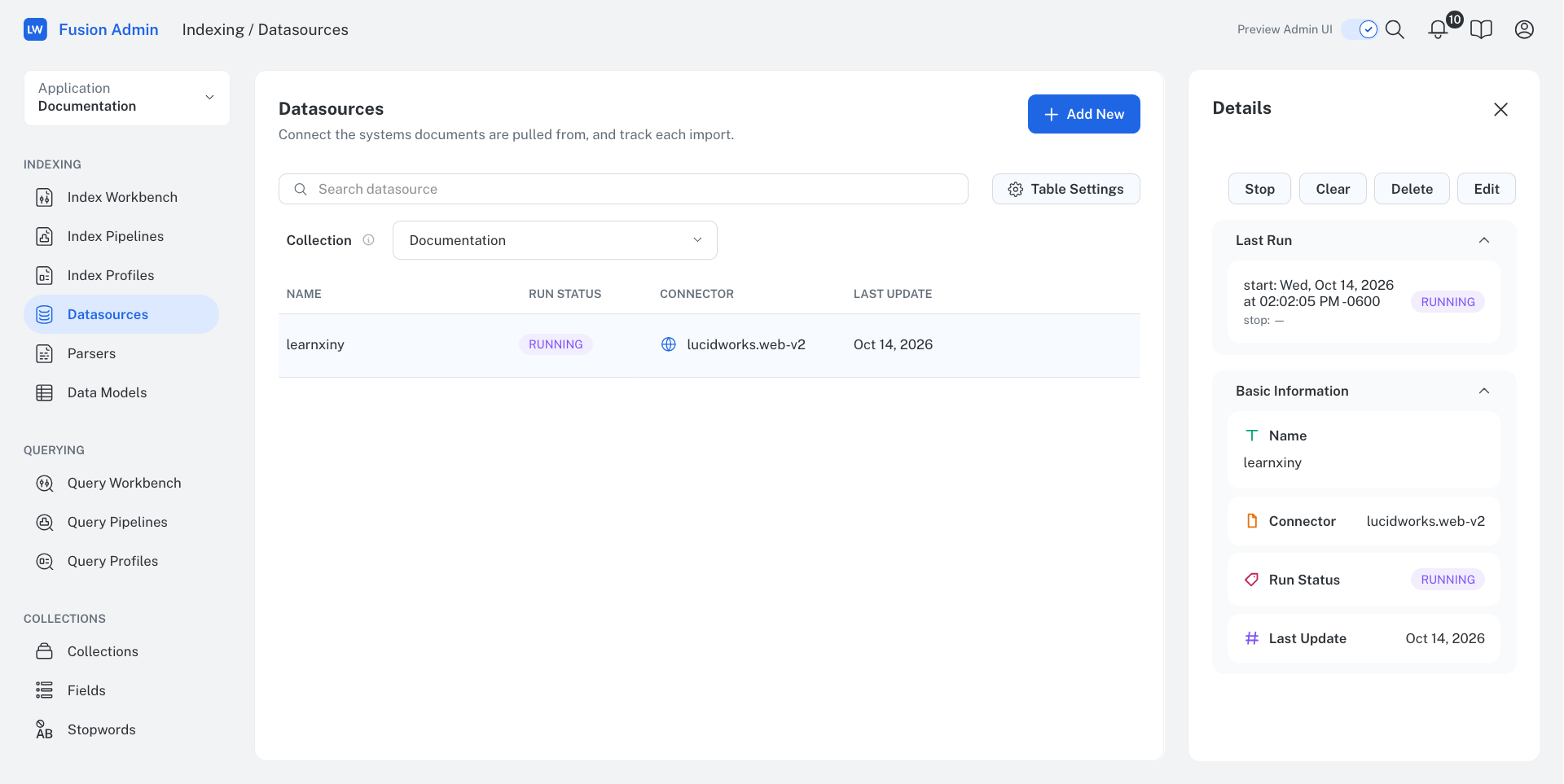
New UI
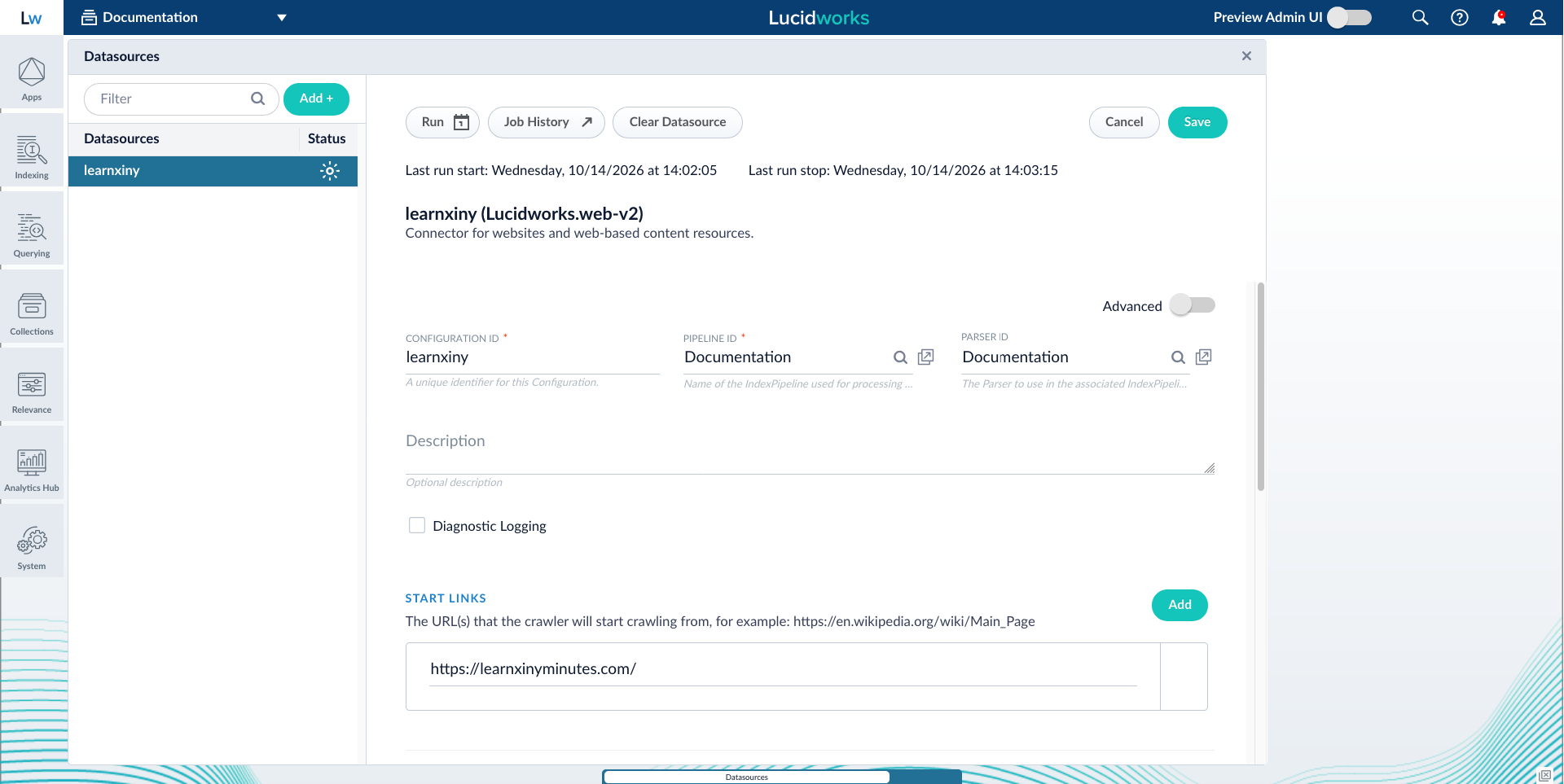
Legacy UI
**Object Explorer**
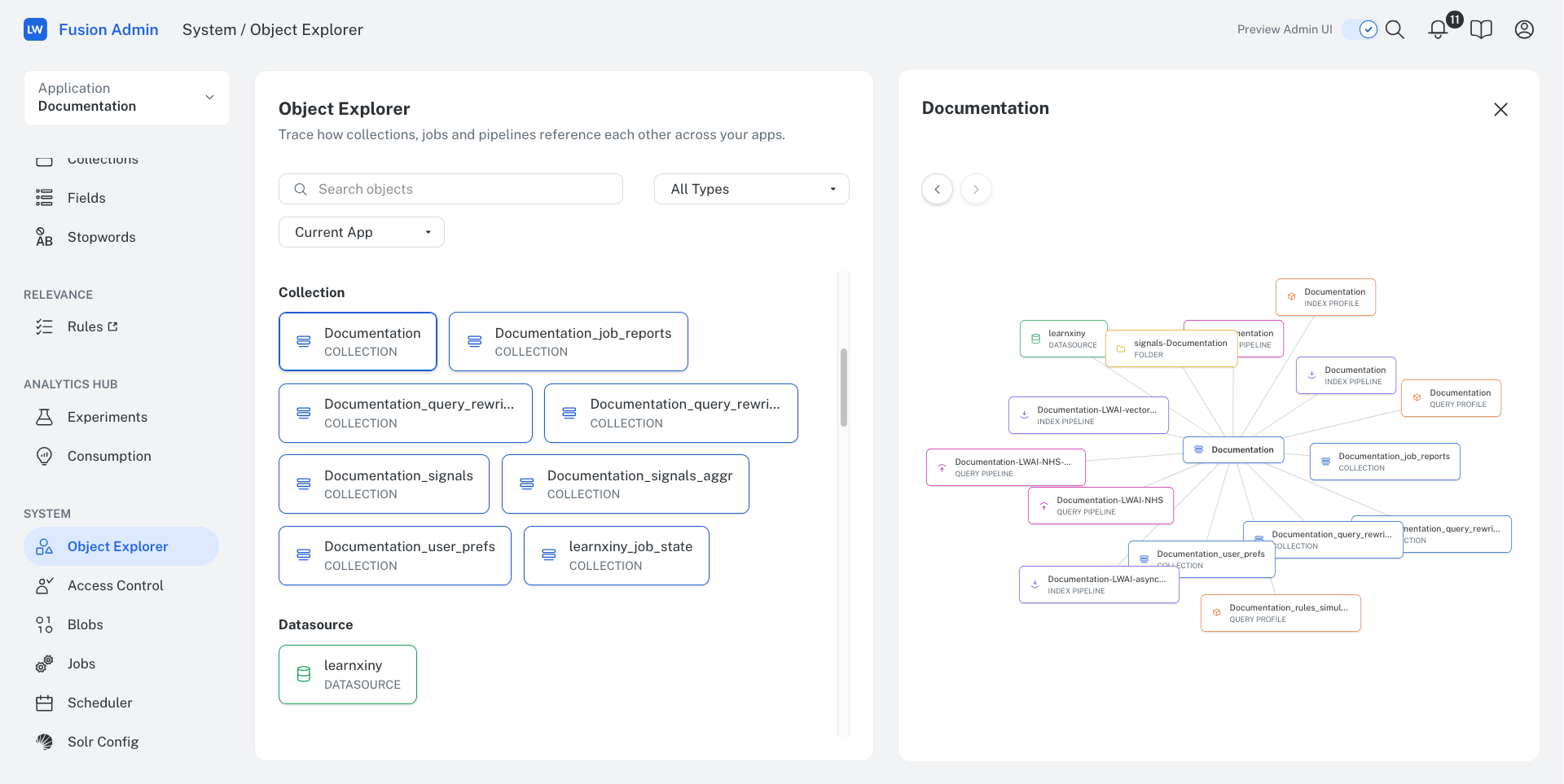
New UI
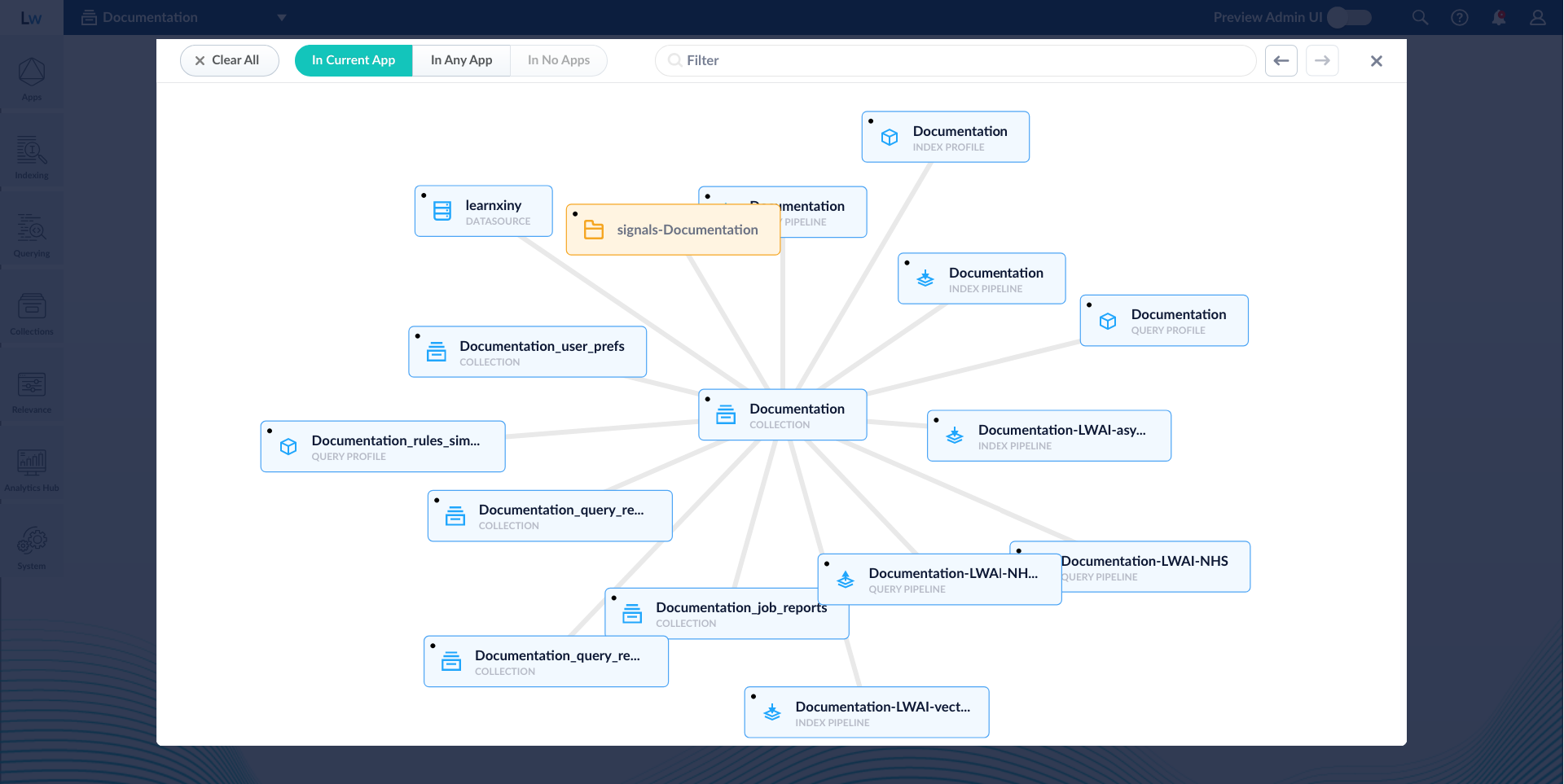
Legacy UI
**Index Workbench**
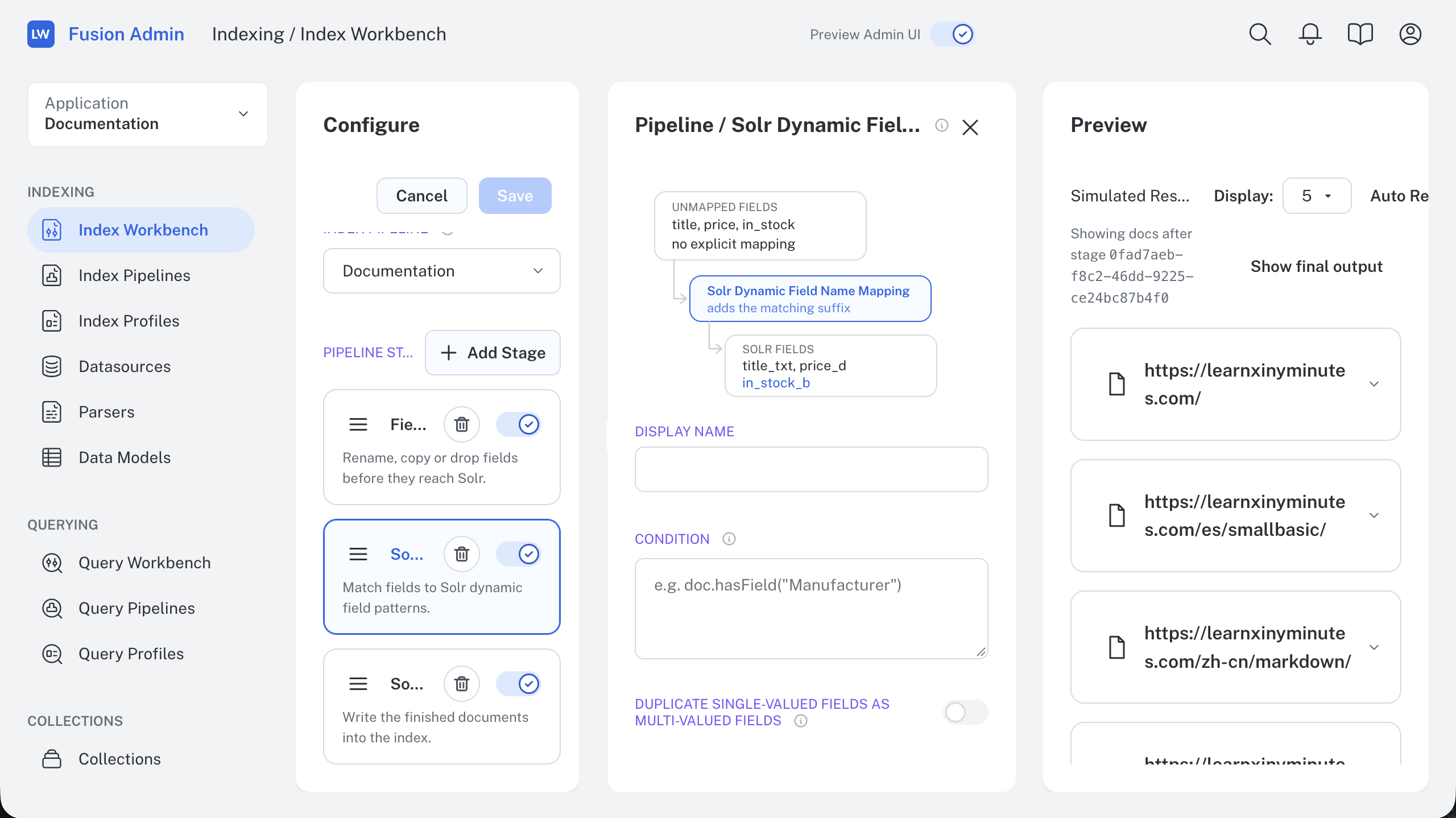
New UI
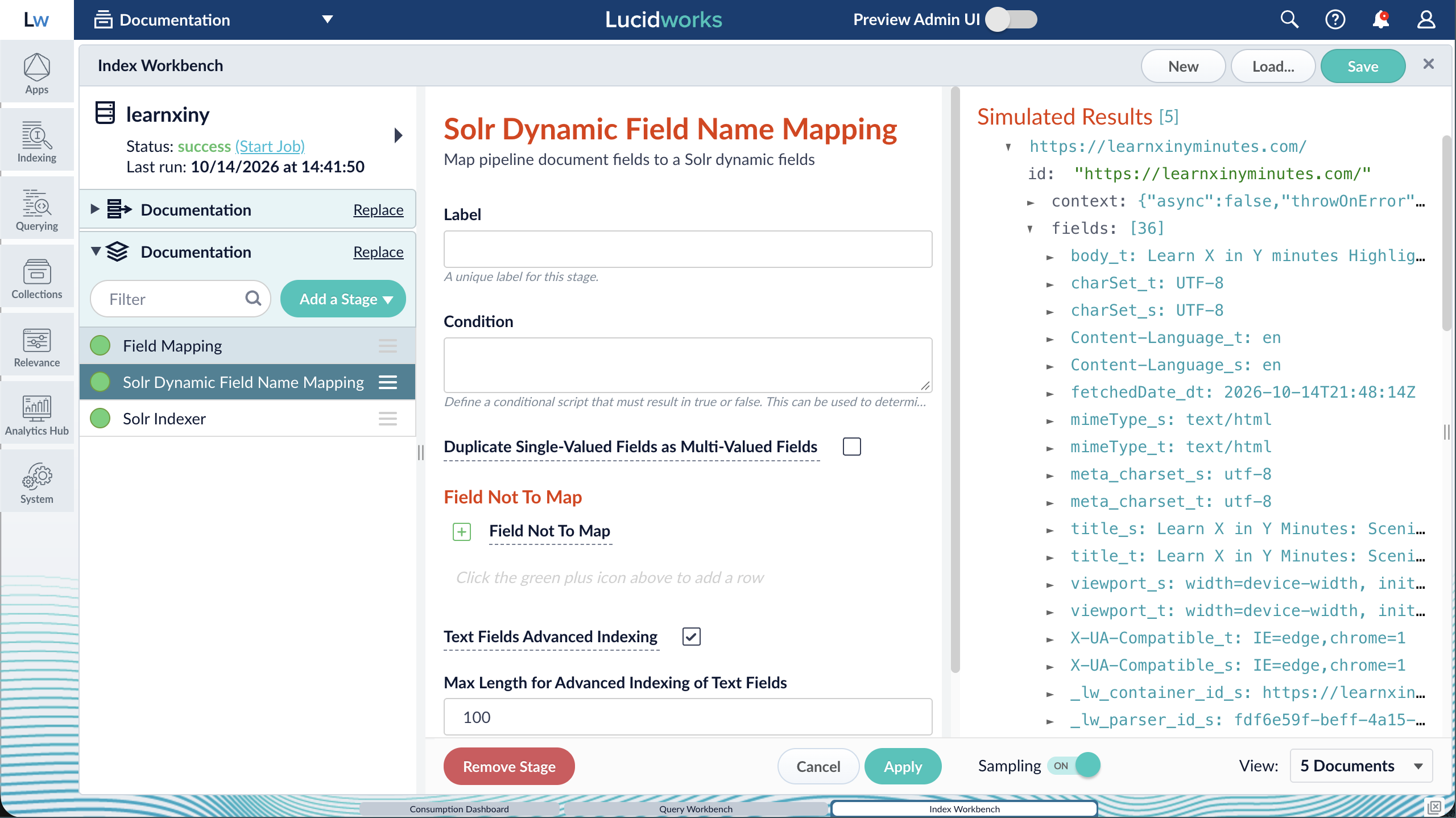
Legacy UI
**Query Workbench**
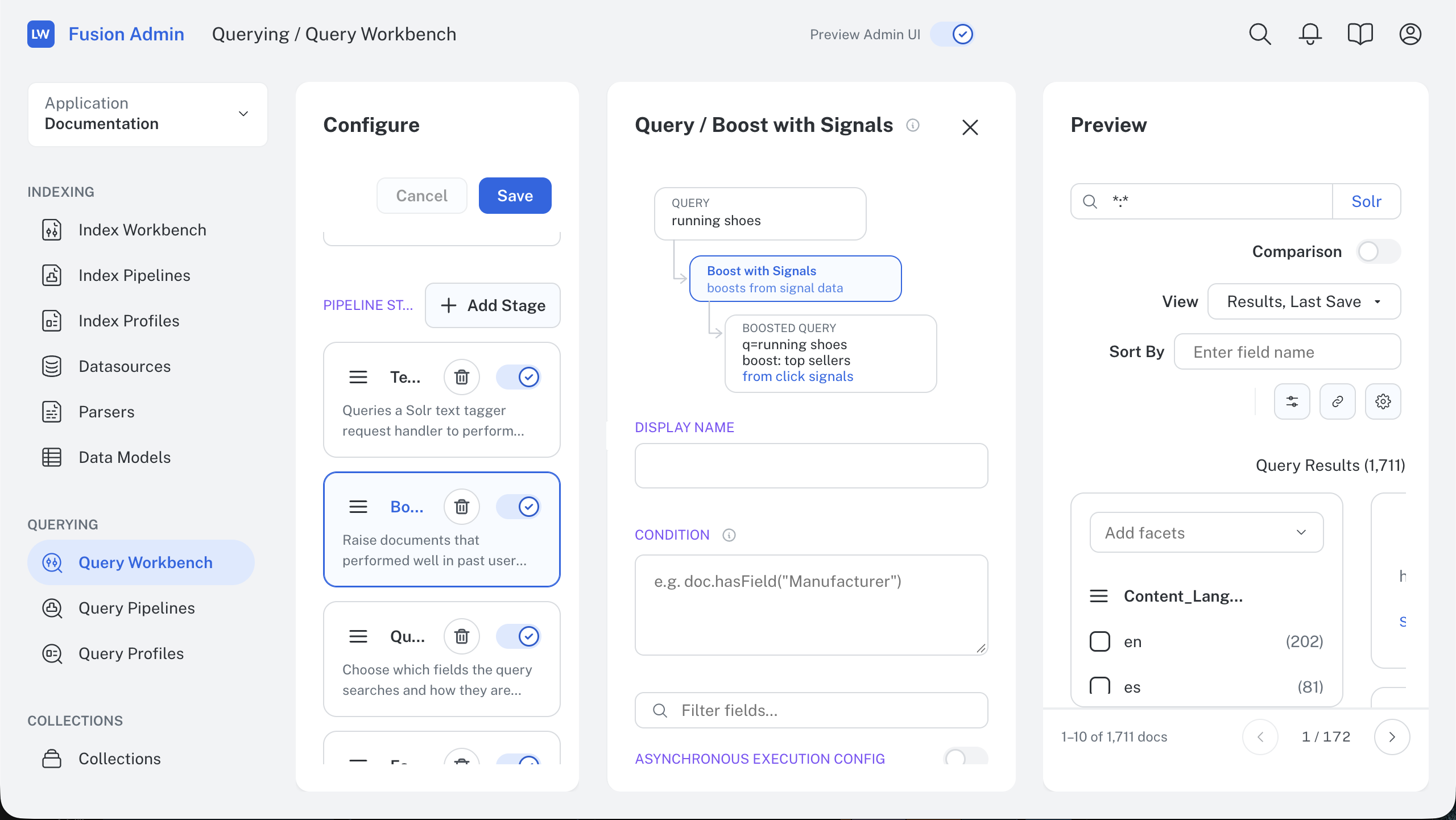
New UI
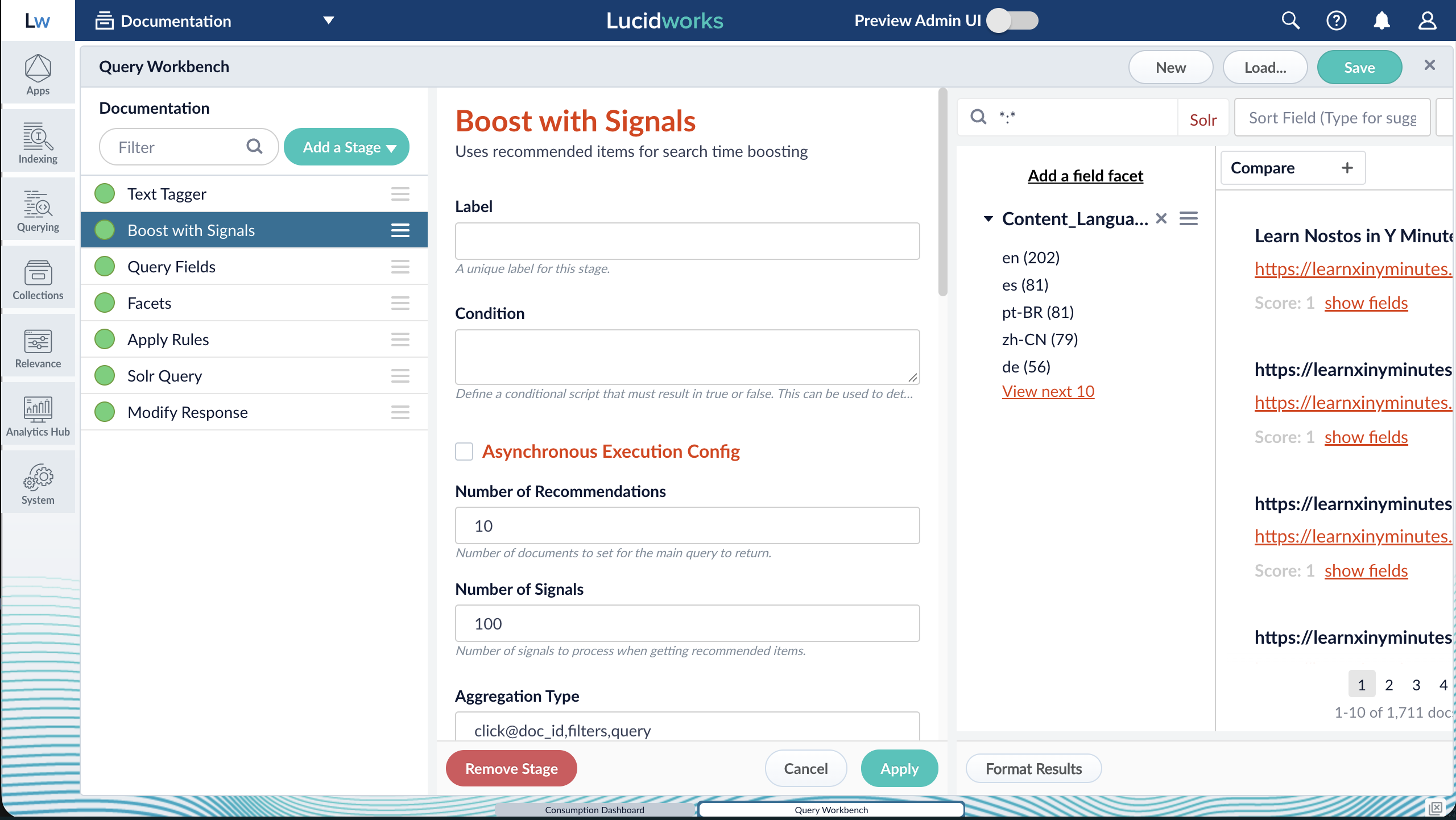
Legacy UI
**Quickstart**

To try it, use the toggle in the top bar of the Admin UI.
The toggle is in both the legacy and new Admin UI, so you can switch between them at any time, and your apps and objects are all there.
Most menu items keep their familiar names and groups, but a few have moved or aren't in the preview yet.
For example, **Jobs** is now under **System**.
Because this is a preview, capabilities and screen locations may change before general availability.
For how to switch between UIs and a full map of where menu items went, see [Try the New Admin UI](/docs/lucidworks-search/new-fusion-ui.md).
### ETL indexing
ETL Indexing is a new, lightweight indexing operator for bulk-loading large catalogs from your Google Cloud Storage bucket into an index pipeline or directly into Solr, providing an alternative to the Parallel Bulk Loader (PBL) for this use case. Unlike PBL, ETL indexing runs as a single pod and doesn't require a Spark cluster, reducing the infrastructure footprint needed for large bulk-load jobs.
You can create, run, and schedule ETL indexing jobs in the Lucidworks Search UI. Each job writes an indexing request to your cloud storage bucket, and the ETL Indexer processes these requests. If the ETL Indexer pod fails or restarts, the indexer resumes the request instead of starting over. ETL indexing also exports metrics for documents indexed, failed documents, and throughput, so you can monitor job progress in Grafana.
Contact your Lucidworks representative to enable ETL indexing.
Lucidworks recommends testing ETL indexing with your catalog data and moving your bulk-load jobs from PBL to ETL indexing.
The LucidAcademy course below includes guidelines for deciding when to use ETL indexing.

> **[ETL Indexing in Lucidworks Search](https://academy.lucidworks.com/scorm/01a1389a-4d70-7c2d-b5bf-a6d833d9bda4)**
>
> The course for **ETL Indexing in Lucidworks Search** focuses on when to use the ETL Indexer to bulk-load structured catalog data from Google Cloud Storage, how to configure and schedule jobs for one or more collections, and how to monitor and troubleshoot indexing requests.
### Scale indexing automatically with KEDA
Indexing can now scale out and back in automatically as indexing load changes, using a KEDA-based autoscaling trigger.
Delete-by-query and ACL operations now use Kafka offsets as the source of truth, so no operations are duplicated or lost when pods join or leave during a scale event.
Rebalancing uses cooperative partition assignment, so the pods that keep running continue indexing while partitions move.

You pay for extra indexing capacity only while a burst, such as a full catalog refresh, needs it.
Large updates finish sooner, so changes become searchable faster, and nobody has to scale pods by hand before a known spike.
Autoscaling is off by default.
To enable it for your deployment, contact your Lucidworks representative.
### Debug query rewrites faster
You can now turn off specific query rewrites for a single query, the same way you already can for rules.
This lets you find which rewrite causes an unexpected result without changing your live configuration.
To suppress rewrites, pass their IDs in `executionModifiers` on the `/preview` endpoint.
The response still shows which rewrites would have fired, but they don't affect the results.
For example, if a search for "apple charger" ranks laptop power adapters above phone cables, preview the query once with a brand rewrite suppressed and once with a synonym rewrite suppressed.
Whichever change fixes the ranking identifies the rewrite to adjust, and shoppers never see the test.

### Connectors improvements
Lucidworks Search 5.19 includes several updates that streamline the connectors platform and make crawls more reliable.
* **Consistent security trimming across V2 connectors.**
V2 connectors now use graph-based security trimming as their single security-trimming model, so access control works the same way across connectors and the connectors SDK is simpler to build against.
To support this, Lucidworks Search removes the legacy static and dynamic security-trimming code paths from the connectors SDK and the `fusion-connectors` service.
Custom connectors built on the static or dynamic security-trimming APIs must move to graph-based security trimming.
* **More reliable Web v2 crawling.**
Lucidworks Search ships safer default Selenium Grid settings, using modern Selenium 4 environment variable names.
This avoids hung nodes, out-of-memory failures, and silent capacity limits during Web v2 JavaScript-evaluation crawls.
### Parsing and indexing improvements
Lucidworks Search 5.19 includes an update that prevents conflicting stage configurations in the Lucidworks Search UI.
* **Fewer conflicting pipeline configurations.**
When you configure a query pipeline stage in the Lucidworks Search UI, settings that are alternatives to each other now accept only one choice, so you can't save a stage with conflicting settings.
For example, in the Query Fields stage, **Group Leader Strategy** now lets you fill in either **By Field Value** or **By Sort**, not both.
Previously, only the field description said that these settings couldn't be combined.
### Observability improvements
Lucidworks Search 5.19 extends OpenTelemetry tracing coverage across more services and message boundaries.
* **Broader OpenTelemetry tracing coverage.**
Lucidworks Search adds OpenTelemetry tracing support to the Apps Manager and Admin services, extending the distributed tracing already available for other supported services.
* **End-to-end tracing through Kafka.**
Lucidworks Search propagates the W3C `traceparent` header through Kafka messages, creating a continuous distributed trace span from the originating message through downstream consumers instead of losing trace context at the message boundary.
## API changes
* **API for duplicating datasources.**
A new `POST /connectors/datasources/{id}/duplicate` endpoint creates a new datasource by copying the configuration of an existing V2 (SDK) datasource. You provide the ID for the new datasource and can optionally override its description, app, and collection. Classic (V1) datasources can't be duplicated.
See [Fusion APIs](/api-reference/datasource-configuration-api/duplicate-a-datasource.md) for an example.
This lays the groundwork for a future Duplicate action in the datasource UI, so datasources with mostly identical configuration no longer need to be recreated from scratch.
* **Option to create Kafka topics for subscriptions.**
The `POST /subscriptions` and `PUT /subscriptions/{id}` endpoints accept a new optional `create` query parameter. When `create` is `true`, Lucidworks Search creates the subscription's Kafka topic if it doesn't already exist, instead of rejecting the request.
See [Fusion APIs](/api-reference/subscriptions-api/create-a-subscription) for details.
* **OAuth scopes in Proxy API responses.**
The `POST /oauth2/register` response now includes a `scope` field that lists the scopes granted to the registered client. The `GET /.well-known/oauth-protected-resource` response now includes a `scopes_supported` field that lists the scopes the protected resource supports.
See [Fusion APIs](/api-reference/oauth-20/register-oauth-21-client.md) for details.
* **Admin API spec shows lowercase enum values.**
The Admin API spec now shows these enum values in lowercase, matching what the API has always sent and accepted:
* `AuthConfig.authType`: `none`, `basic`, and `kerberos`.
* `CallParams.method`: `get`, `put`, `post`, and `delete`.
* The `type` field in `AnyType` and `ObjectType`: `string`, `number`, `integer`, `boolean`, `object`, `array`, `null`, and `ref`.
Earlier versions of the spec showed these values capitalized, such as `NONE` or `String`.
The API accepts these values in any case, so requests that use uppercase values continue to work, but responses always use lowercase.
No changes to your applications are needed.
See [Fusion APIs](/api-reference/search-cluster/create-a-cluster.md) for an example of a schema that uses `AuthConfig`.
* **Parser updates create missing parsers.**
The Async Parsing `PUT /async-parsing/parsers/{id}` endpoint now creates the parser if no parser with the specified ID exists, instead of only updating an existing parser.
See [Fusion APIs](/api-reference/parsers-crud-api/update-a-parser.md) for an example.
- **Connectors SDK 4.3.0.**
Lucidworks Search 5.19 supports Connectors SDK 4.3.0, which adds graph-based security trimming with a sidecar collection.
For the SDK version that matches each release, see the [Connectors SDK support matrix](/docs/5/fusion/dev-portal/connectors-sdk/overview.md#connectors-sdk-support-matrix).
## Bug fixes
### Connectors
* **The first recrawl after upgrading to 5.18.0 reindexed all documents.**
In Lucidworks Search 5.18.0, where this issue was first found, the first recrawl after upgrading from 5.9 through 5.17 treated every document in each affected datasource as changed and sent it through indexing again, because those earlier versions don't store document signatures.
This known issue from Lucidworks Search 5.18 is fixed.
Upgrading to Lucidworks Search 5.19.0 no longer causes a full reindex on the first recrawl.
* **Some connectors re-fetched every item on every recrawl.**
In previous versions of Lucidworks Search, starting with 5.18.0, Web V2, file system, and SMB connectors didn't receive the stored state they use to skip unchanged items, such as ETag and Last-Modified values for Web V2 or modification times for files. As a result, every recrawl re-fetched every page or re-read every file instead of only changed items. This issue is fixed.
Lucidworks Search now replays stored state to connectors on recrawl, so they fetch only changed items.
* **Nested connector properties displayed out of order.**
In previous versions of Lucidworks Search, the connector configuration UI ignored the `@Property(order = N)` annotation on nested or grouped properties, so nested fields appeared in an unpredictable order.
This issue is fixed.
Lucidworks Search now applies the declared order to nested properties as well as top-level properties.
- **Connector jobs hung on unexpected crawl errors.**
In previous versions of Lucidworks Search, some unexpected crawl errors, such as a missing reactor error handler or a CrawlDB write failure, could leave connector jobs hanging indefinitely instead of failing.
This issue is fixed.
Lucidworks Search now fails these jobs with a meaningful error message.
- **Cleared datasource values appeared masked.**
In previous versions of Lucidworks Search, clearing a datasource configuration value and saving it could cause the field to show masked dots instead of appearing empty.
This issue is fixed.
Lucidworks Search now displays cleared values as empty.
- **Brief Solr outages failed connector jobs.**
In previous versions of Lucidworks Search, a transient Solr outage during a connector job's unprocessed-document count check could cause the job to fail.
This issue is fixed.
Lucidworks Search now retries this request, so brief Solr interruptions no longer fail the job.
- **Connector Helm charts exposed TLS passwords.**
In previous versions of Lucidworks Search, connector Helm charts rendered TLS keystore and truststore passwords in plaintext in Kubernetes resources, where anyone with read access to those resources could see them.
This issue is fixed.
Lucidworks Search now keeps these passwords out of rendered resources, matching the fix already applied to other services.
- **Some Microsoft Office documents failed to parse.**
In previous versions of Lucidworks Search, a parser initialization error caused some Microsoft Office documents to fail to parse, so their content wasn't indexed.
This issue is fixed.
Lucidworks Search now parses these documents correctly.
- **Connectors included a Solr remote code execution vulnerability.**
In previous versions of Lucidworks Search, `connectors-backend` bundled a version of `solr-core` affected by CVE-2025-24814, a remote code execution vulnerability.
This issue is fixed.
Lucidworks Search now removes or upgrades the vulnerable dependency in `connectors-backend`.
- **Connectors included a Netty denial-of-service vulnerability.**
In previous versions of Lucidworks Search, the gRPC library in `fusion-connectors` bundled a Netty version affected by CVE-2025-55163, an HTTP/2 vulnerability that attackers could use to cause a denial of service.
This issue is fixed.
Lucidworks Search now uses a gRPC version that bundles a patched Netty.
Connector plugin loading is unaffected.
- **Connector plugins could fill the Kafka volume.**
In previous versions of Lucidworks Search, each connector plugin published its full configuration to a Kafka topic every second, about 18 GB per day, so several plugins could fill the Kafka volume and take the deployment down.
This issue is fixed.
Lucidworks Search now publishes plugin availability every 60 seconds instead of every second, compresses these messages, and limits the size and retention of the `fusion.connectors.plugin-notifications` topic.
### Search and query
* **Boost rules applied boosts to the wrong terms.**
In previous versions of Lucidworks Search, the `block_groups_list` feature of `BoostAttributesRule` could bind a boost factor to the wrong term and incompletely escape generated boost function queries, so results were boosted incorrectly.
This issue is fixed.
Lucidworks Search now binds boost factors to their intended terms and fully escapes generated queries.
* **Pinned documents ignored the `fl` field list.**
In previous versions of Lucidworks Search, pinned documents returned all fields instead of the fields set by `fl` in the Query Fields stage.
This issue is fixed.
Lucidworks Search now applies the same `fl` filter to pinned documents as to organic results.
* **Pinned rules stopped working after upgrading to 5.17.2.**
In previous versions of Lucidworks Search, upgrading to 5.17.2 could cause working pinned rules to stop applying, because pin rule processing changed how the boost list rule rewrote the query.
This issue is fixed.
Lucidworks Search now applies pinned rules consistently after upgrading.
* **Pinned documents appeared twice.**
In previous versions of Lucidworks Search, a document that pinning moved to a later results page could appear twice: once at its organic rank and again at its pinned position.
This issue is fixed.
Lucidworks Search now removes the duplicate entry.
* **Multi-phase pinning returned inconsistent results.**
In previous versions of Lucidworks Search, multi-phase pinning could return more documents than the requested `rows` value, and its supplemental lookup query could inherit an unintended `defType` from earlier rule processing.
This issue is fixed.
Lucidworks Search now truncates merged results to the requested page size and forces `defType=lucene` on the supplemental lookup query.
* **Multi-phase pinning dropped `fl` fields and `fq` filters.**
In previous versions of Lucidworks Search, the multi-phase pinning supplemental query kept only the first `fl` value and ignored non-collapse `fq` filters, so pinned documents could be missing fields or ignore filters.
This issue is fixed.
Lucidworks Search now preserves all requested `fl` fields and applies `fq` filters to the supplemental query.
* **Pinning many documents caused URI Too Long errors.**
In previous versions of Lucidworks Search, the multi-phase pinning supplemental query could fail with an HTTP 414 URI Too Long error when many pinned documents needed to be fetched.
This issue is fixed.
Lucidworks Search now sends this query as a POST request, which avoids URI length limits.
### Parsing and indexing improvements
* **Large bulk index requests timed out.**
In previous versions of Lucidworks Search, the Index Pipelines API could time out on bulk index requests of 400 or more documents, causing batch jobs to fail with read timeout errors.
This issue is fixed.
Lucidworks Search now handles large bulk index batches without timing out.
### Security and dependency updates
* **SnakeYAML 1.x exposed Lucidworks Search to known vulnerabilities.**
In previous versions of Lucidworks Search, services used SnakeYAML 1.x, which has known CVEs.
This issue is fixed.
Lucidworks Search now uses SnakeYAML 2.x.
- **Invalid Vault credentials weren't detected until query time.**
In previous versions of Lucidworks Search, the Active Directory Security Trimming stage and JavaScript stages (GraalVM, Nashorn, and OpenJDK Nashorn) resolved Vault-backed credentials on each request instead of at stage initialization.
Pipelines with invalid or unavailable credentials deployed successfully and failed only when the first query arrived.
This issue is fixed.
Lucidworks Search now resolves and validates Vault-backed credentials during stage initialization, so configuration problems surface at deploy time.
- **Base container images included known vulnerabilities.**
In previous versions of Lucidworks Search, base container images included packages with known vulnerabilities.
This issue is fixed.
Lucidworks Search now uses updated base container images.
- **Some services used an older Netty version.**
In previous versions of Lucidworks Search, some services used an older Netty version than the rest of the platform, so they lacked the latest Netty security patches.
This issue is fixed.
Lucidworks Search now uses the same Netty version across all services.
### SDKs and services
* **The LWAI Batch Vectorize stage failed when its token expired.**
In previous versions of Lucidworks Search, the LWAI Batch Vectorize stage could keep using an expired authentication token and didn't clearly report the resulting failure.
This issue is fixed.
Lucidworks Search now refreshes the token before it expires and reports authentication failures clearly.
### Operational stability and build reliability
* **API Gateway requests were intermittently slow.**
In previous versions of Lucidworks Search, starting with 5.17.2 and 5.18.0, a small percentage of API Gateway requests took more than a second to complete, even though query pipeline and Solr execution remained fast.
This issue is fixed.
Lucidworks Search now delivers consistent API Gateway request latency under load.
* **Solr was affected by a configset remote code execution vulnerability.**
In previous versions of Lucidworks Search, the bundled Solr 9.6.1 was affected by CVE-2025-24814, a vulnerability in how Solr loads `` directives from configsets.
The default configsets don't use `` directives, but this issue is fixed.
Lucidworks Search now includes the upstream Solr fix, which ignores `` directives in `solrconfig.xml` by default.
> [!WARNING]
>
> If a custom configset uses `` directives to load JAR files, contact Lucidworks Support before your deployment is upgraded.
> Otherwise, Solr ignores those directives and doesn't load the JAR files.
## Known issues
* **Running more than one MCP server replica breaks the `/mcp` endpoint.**
MCP sessions are stored in each pod, so requests routed to a different replica fail.
* **Collections with mixed replica types can fail to create on 3-node clusters.**
Creating a collection with NRT, TLOG, and PULL replicas can fail with a "Not enough eligible nodes" error on a 3-node high-availability cluster.
* **The Parallel Bulk Loader can duplicate documents during atomic updates.**
When `atomicUpdates` is `true` and `outputPartitions` is greater than `1`, the job adds duplicate documents instead of updating existing ones.
* **Calls between services can fail intermittently in multi-replica deployments.**
Service discovery can intermittently lose healthy services, so calls fall back to `http://:80` and fail.
This can affect deployments and API calls to services such as `fusion-admin` and `classic-rest-service`.
* **Indexing can drop documents without reporting an error.**
When Solr is temporarily unavailable, under heavy load, or returns errors, the index pipeline can discard documents after logging a warning or error.
The connector job still reports success, so the missing documents aren't indexed and no failure is surfaced.
Compare document counts in the datasource and the collection after large indexing jobs.
## Deprecations
Lucidworks Search 5.19 deprecates these features, which are expected to be removed in Fusion 6.0:
* **Legacy Admin UI.** Use the [new Admin UI](/docs/lucidworks-search/new-fusion-ui.md) instead.
* **Reverse Search.**
* **Seldon.** This includes the Create Seldon Core Model Deployment and Delete Seldon Core Model Deployment jobs, and Seldon models in the Ray/Seldon Vectorize Field and Ray/Seldon Vectorize Query stages.
* **Content-Based Recommender job.**
* **Smart Answers Supervised Training job.**
* **Smart Answers Evaluate Pipeline job.**
* **`fusion-classification` service.**
* **gRPC `ml-model-service` API.**
For details, see [Deprecations and Removals](/docs/lucidworks-search/deprecations-and-removals.md).
## Removals
Lucidworks Search 5.19 removes these connectors framework features:
* **Static and dynamic security trimming.** V2 connectors now support only graph-based security trimming.
* **Connectors `ConfigsApi` endpoints.** Use the `DataSourcesApi` endpoints instead.
For details, see [Fusion Connectors Deprecations and Removals](/docs/fusion-connectors/deprecations-and-removals.md#connectors-platform-features).
## Platform support and component versions
### Kubernetes platform support
Lucidworks Search is deployed and managed on Google Kubernetes Engine (GKE) 1.31, 1.32, 1.33, 1.34, 1.35, and 1.36.
For more information on Kubernetes version support, see the [Kubernetes support policy](/docs/policies/lifecycle-policies/lw-semantic-version-support-lifecycle.md#kubernetes-support).
### Component versions
The following table details the versions of key components used in Lucidworks Search 5.19.0.
| Component | Version |
| - | - |
| Solr | fusion-solr 5.19.0 *(based on Solr 9.6.1)* |
| ZooKeeper | 3.9.1 |
| Spark | 3.4.1 |
| Ingress Controllers | Nginx, Ambassador (Envoy), GKE Ingress Controller |
| Ray | ray\[serve] 2.56.0 |
| Helm | 4.1.1 |
See [Lucidworks Semantic Version Support Lifecycle](/docs/policies/lifecycle-policies/lw-semantic-version-support-lifecycle.md) for more information about support dates.
This documentation is built and hosted on [Mintlify](https://mintlify.com), a developer documentation platform.