> ## Documentation Index
> Fetch the complete documentation index at: https://doc.lucidworks.com/llms.txt
> Use this file to discover all available pages before exploring further.

# Call Pipeline Index Stage

export const schema = {
  "type": "object",
  "title": "Call Pipeline",
  "description": "Call another Fusion indexing pipeline",
  "required": ["collection", "pipeline"],
  "properties": {
    "skip": {
      "type": "boolean",
      "title": "Skip This Stage",
      "description": "Set to true to skip this stage.",
      "default": false,
      "hints": ["advanced"]
    },
    "label": {
      "type": "string",
      "title": "Label",
      "description": "A unique label for this stage.",
      "hints": ["advanced"],
      "maxLength": 255
    },
    "condition": {
      "type": "string",
      "title": "Condition",
      "description": "Define a conditional script that must result in true or false. This can be used to determine if the stage should process or not.",
      "hints": ["code", "code/javascript", "advanced"]
    },
    "collection": {
      "type": "string",
      "title": "Collection"
    },
    "pipeline": {
      "type": "string",
      "title": "Pipeline ID"
    }
  },
  "category": "Advanced",
  "categoryPriority": 3,
  "unsafe": false
};

export const SchemaParamFields = ({schema}) => {
  const sanitize = str => {
    if (typeof str !== "string") return str;
    return str.replace(/^"(.*)"$/s, "$1").replace(/\\/g, "").replace(/"/g, "'");
  };
  const formatDescription = str => {
    const s = sanitize(str);
    return (/[.!?]\)*$/).test(s) ? s : `${s}.`;
  };
  const {description, properties = {}, required: requiredProps = []} = schema;
  const visibleProps = useMemo(() => Object.entries(properties).filter(([, prop]) => !prop.hints?.includes("hidden")), [properties]);
  return <div>
      {description && <p>{formatDescription(description)}</p>}

      {visibleProps.map(([name, prop]) => {
    const isRequired = requiredProps.includes(name);
    const hasDefault = prop.default !== undefined;
    const rawDefault = prop.default;
    const isComplexDefault = hasDefault && (typeof rawDefault === "object" || typeof rawDefault === "string" && (rawDefault.length > 20 || rawDefault.includes('"')));
    const fieldProps = {
      key: name,
      body: prop.title || name,
      type: prop.type,
      ...prop.title && ({
        post: [<><span className="text-stone-400 dark:text-stone-500">API property: </span>{name}</>]
      }),
      ...isRequired && ({
        required: true
      }),
      ...!isComplexDefault && hasDefault ? {
        default: sanitize(String(rawDefault))
      } : {}
    };
    const isObject = prop.type === "object" && prop.properties;
    const isArrayOfObjects = prop.type === "array" && prop.items?.type === "object" && prop.items.properties;
    return <ParamField {...fieldProps}>
            {prop.description && <p>{formatDescription(prop.description)}</p>}

            {isComplexDefault && <div className="flex">
                <p>
                  <strong>Default:</strong>
                </p>
                <pre className="!my-0">
                  <code>
                    {JSON.stringify(rawDefault, null, 2)}
                  </code>
                </pre>
              </div>}

            {isArrayOfObjects && <div className="flex">
              <p>
                <strong>Object attributes:</strong>
              </p>
              <pre className="!my-0">
                <code>
                  {'{\n'}
                  {Object.entries(prop.items.properties).map(([iname, iprop]) => <>
                      {`  ${iname}`}
                      {prop.items?.required?.includes(iname) && <span style={{
      color: 'red'
    }}> required</span>}
                      {`: {\n    display name: ${sanitize(iprop.title || '')}\n    type: ${iprop.type}\n  }\n`}
                    </>)}
                  {'}'}
                </code>
              </pre>
              </div>}

            {isObject && <Expandable title="properties">
                <SchemaParamFields schema={{
      properties: prop.properties,
      required: prop.required
    }} />
              </Expandable>}
          </ParamField>;
  })}
    </div>;
};

export const LwTemplate = ({title = "Key questions to get you started", icon = "sparkles", cta = "Powered by Agent Studio", linkHref = "https://lucidworks.com/demo/?utm_source=docs&utm_medium=referral&utm_campaign=docs_cta_ai"}) => {
  const [isLoaded, setIsLoaded] = useState(false);
  useEffect(() => {
    const timer = setTimeout(() => {
      setIsLoaded(true);
    }, 500);
    return () => clearTimeout(timer);
  }, []);
  return <div className="lw-template-container">
      <Card title={title} icon={icon}>
        {isLoaded && <span dangerouslySetInnerHTML={{
    __html: `<lw-template id="a029c1a9-28be-427e-b0e1-5d918920246a"></lw-template
            >`
  }} />}
        <Link href={linkHref} className="agent-studio-link text-left text-gray-600 gap-2 dark:text-gray-400 text-sm font-medium flex flex-row items-center hover:text-primary dark:hover:text-primary-light group-hover:text-primary group-hover:dark:text-primary-light">Powered by Lucidworks Agent Studio</Link>
      </Card>
    </div>;
};

[localhost link]: http://localhost:3000/docs/5/fusion/reference/config-ref/pipeline-stages/index-stages/call-pipeline-index-stage

[mintlify link]: https://doc.lucidworks.com/docs/5/fusion/reference/config-ref/pipeline-stages/index-stages/call-pipeline-index-stage

[old doc.lw link]: https://doc.lucidworks.com/fusion/5.9/214

The Call Pipeline index stage calls another index pipeline.
You can use this stage to reuse pipeline logic across multiple pipelines.
You can also use it to index certain data separately from the rest, update a data model, or distribute indexing across multiple collections or pods.

In the context of an index pipeline, the Call Pipeline stage creates a "fork" that runs another pipeline in parallel with the main pipeline.
The called pipeline does not return any data to the pipeline that called it, so it should end with a stage that writes the output to a collection, a data model, or some other endpoint.
Note that this is different than Call Pipeline stages in query pipelines, where the called pipeline does return its output to the pipeline that called it.

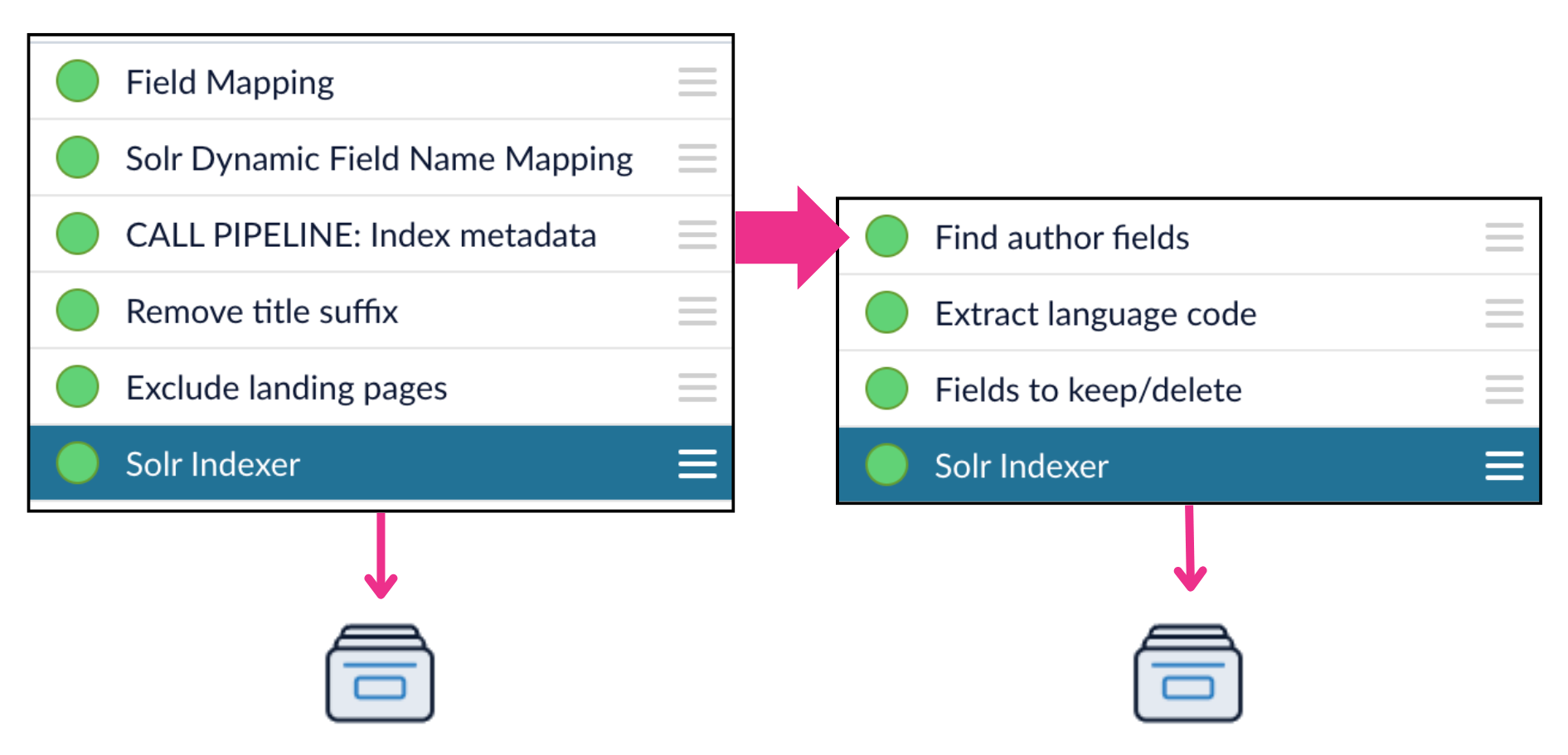
In this example, the main pipeline calls a pipeline that indexes some metadata separately from the main document collection:

<img src="https://mintcdn.com/lucidworks/pcVooZE8fTjtTbXE/assets/images/diagrams/call-pipeline-index1.png?fit=max&auto=format&n=pcVooZE8fTjtTbXE&q=85&s=ccfe41c531e2d695b1ce36787e4692bb" alt="An index pipeline that calls another pipeline" width="1891" height="911" data-path="assets/images/diagrams/call-pipeline-index1.png" />

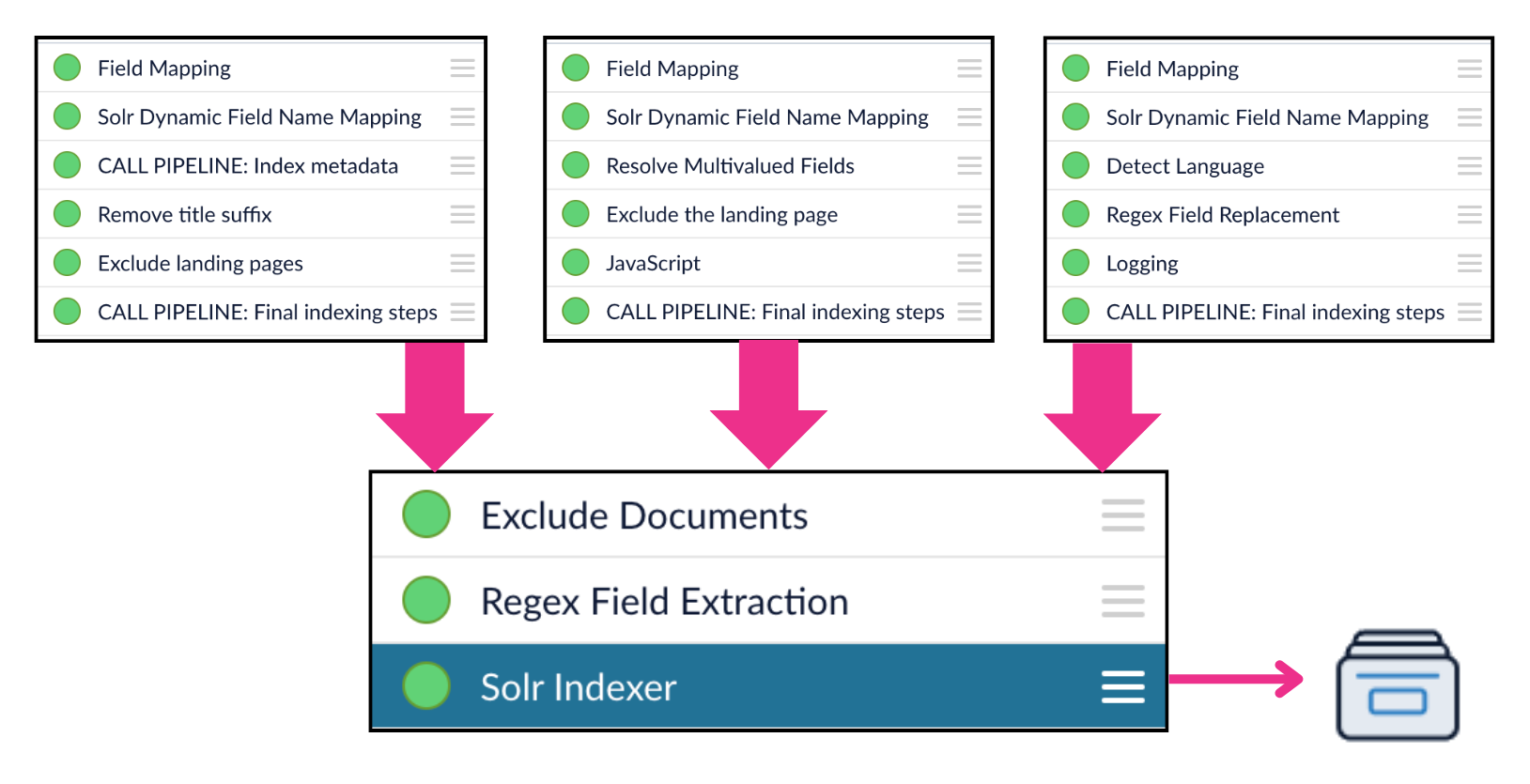
As another example, multiple index pipelines can end with a Call Pipeline stage, and the called pipeline can perform some final processing before indexing the documents; this is a way to reuse pipeline logic so that data from different datasources can be indexed in the same consistent format:
<img src="https://mintcdn.com/lucidworks/pcVooZE8fTjtTbXE/assets/images/diagrams/call-pipeline-index2.png?fit=max&auto=format&n=pcVooZE8fTjtTbXE&q=85&s=85b1d5be49171427770c551c17b33ba1" alt="Three index pipelines that all call the same auxiliary pipeline" width="1629" height="835" data-path="assets/images/diagrams/call-pipeline-index2.png" />

<Tip>
  Use a naming convention for your pipelines that lets you easily differentiate between your main pipelines and the ones you are using as call pipelines.
  For example, you can add a suffix like `_cpl` to differentiate your call pipelines from other pipelines.
</Tip>

<Card title="Using Call Pipelines" class="note-image" href="https://academy.lucidworks.com/using-call-pipelines" cta="Take this course on the LucidAcademy." icon="graduation-cap" iconType="duotone">
  The quick learning for **Using Call Pipelines** focuses on how the Call Pipeline stage works differently in index pipelines versus query pipelines and how to use it in both.
</Card>

<Card title="Call Pipelines" class="note-image" href="https://academy.lucidworks.com/call-pipelines" cta="Take this course on the LucidAcademy." icon="graduation-cap" iconType="duotone">
  The course for **Call Pipelines** focuses on how to implement reusable pipelines and call them from other pipelines.
</Card>

<LwTemplate />

## Configuration

<Tip>
  When entering configuration values in the UI, use *unescaped* characters, such as `\t` for the tab character. When entering configuration values in the API, use *escaped* characters, such as `\\t` for the tab character.
</Tip>

<SchemaParamFields schema={schema} />